Introduction: why polymer quality is not an abstraction
Polymer materials have penetrated almost all industries - from road construction to medical equipment. However, for an engineer responsible for the strength and durability of a structure, it is important not only to know what the polymer consists of, but also confidently operate with facts, parameters, control methods.
Modern testing of polymer materials requires the integration of NDT methods, standardized calibration to ISO 7500-1 and the use of specialized software for accurate results.
🔧 "In my practice - from testing pile shells to quality control of geosynthetics on highways - I have been convinced dozens of times: the correctly chosen test method means accidents prevented and millions saved", says a test engineer with 15 years of experience.
Modern testing of polymer materials has long gone beyond the simple “test for tensile strength.” Today we are talking about integration of NDT methods, standardized calibration (according to ISO 7500-1), use of LIMS and video extensometry, use of specialized software and an integrated approach.
What are polymer materials and why test them?
Polymers are materials consisting of long molecular chains, the properties of which are highly dependent on temperature, structure, modifiers and processing conditions. Various polymers are used in road construction, hydraulic structures, as sealants, reinforcing mesh, shells, formwork elements, etc.
🚧 Main categories of polymers:
- Thermoplastics (PE, PP, PVC, PS)
- Thermoset plastics (epoxy, polyester resins)
- Elastomers (rubbers, thermoplastic elastomers)
- Composites (reinforced with fiberglass, carbon)
- Geosynthetics (geotextiles, geogrids, geomembranes)
Why test? To control the material’s compliance with regulatory requirements (GOST, ISO), to guarantee safety and extend the service life of structures. Many defects (inhomogeneity, residual stresses, fatigue) cannot be detected visually.
Polymer Testing Applications
Tests are used in the following areas:
- Construction Laboratories and VET — checking geotextiles, mastics, sealants, reinforcing shells.
- Pipe factories — control of the mechanical properties of products made of HDPE, PP, PVC.
- Bridge and road construction companies — geosynthetics, elastomers, dampers.
- Manufacturers of rubber goods — rubber seals, hoses, couplings.
- Research institutes and engineering centers — pilot tests of composites.
- Quality control at the input of raw materials and at the output of products.
Important: in accordance with GOST 270–84, mechanical tests of rubber are carried out not only for tension, but also for resistance to aging, compression, deformation, hardness (Shore) and abrasion.
Main characteristics to be controlled

To assess the quality and suitability of the polymer material, the following are controlled:
To assess the quality of polymers, 8 main characteristics are monitored: from tensile strength to cracking resistance. Each method has its own GOST or ISO standard.
| Property | Test method | Standards |
|---|---|---|
| Elongation at break | Using a video extensometer | GOST 270–84 |
| Modulus of elasticity | Static stretching or bending | ISO 178, GOST 9550 |
| Compressive strength | Press compression method | GOST 25.603–97 |
| Impact strength | Charpy/Izod pendulum | GOST 4647 |
| Hardness | Shore hardness testers A, D | GOST 24621 |
| Abrasion | Weight loss after cycle | GOST 263–75 |
| Cracking Resistance | By stretching method with a notch | ASTM D1938 |
Formulas for calculating the mechanical properties of polymers
Tensile Strength:
σt = Fmax / A0
Modulus of elasticity:
E = σ / ε = (F × L0) / (A0 × ΔL)
Elongation at break:
εb = (Lb - L0) / L0 × 100%
Impact strength:
K = A / S = mgh(1-cosα) / S
Where:
σt- tensile strength, MPaFmax- maximum load, N- A_0 - initial cross-sectional area, mm²
- E - modulus of elasticity, MPa
- \varepsilon - relative deformation
- \varepsilon_b - elongation at break, %
- K - impact strength, kJ/m²
Mechanical testing methods: from breaking to bending
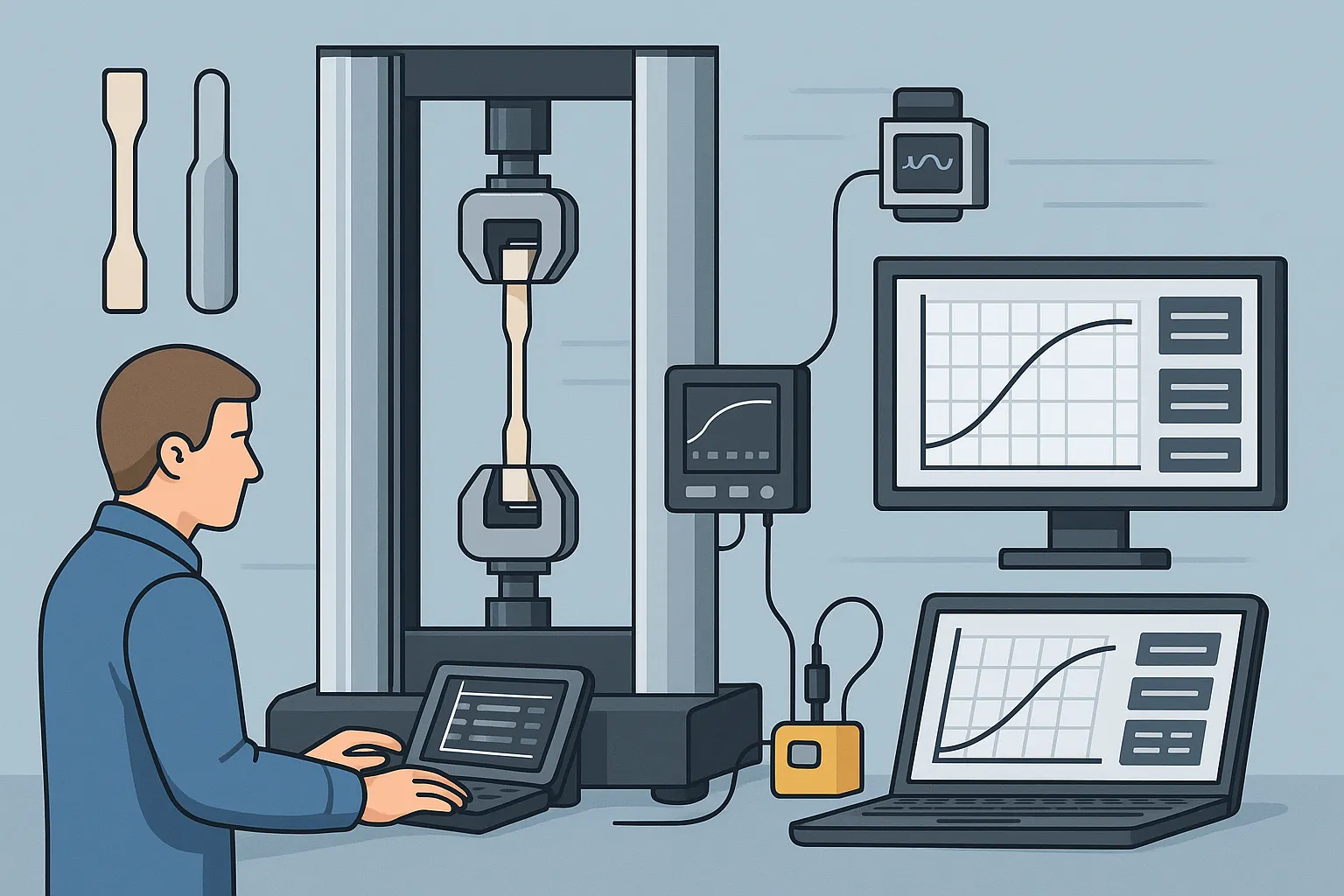
Different methods are used for different types of polymer materials. Below are the key methods that comply with GOST and international standards.
Tensile testing is the most common method for testing the strength of polymers. The measurement accuracy reaches ±1% when using modern equipment with video extensometry.
Tensile test
The most common way to test the strength of plastics, rubber, and geotextiles. The sample is stretched to failure and the force and deformation are measured.
- Standard: GOST 11262-2017 (equivalent to ISO 527-1, ASTM D638)
- What is measured: tensile strength, modulus of elasticity, elongation at break
- Sample Type: blade, with cylindrical gripper
- Equipment: universal testing machine, eccentric or wedge grips, video extensometer (DIC)
📌 Tip: When testing thermoplastics, it is important to maintain a constant temperature - use a heat chamber heated to +80°C.
Compression test
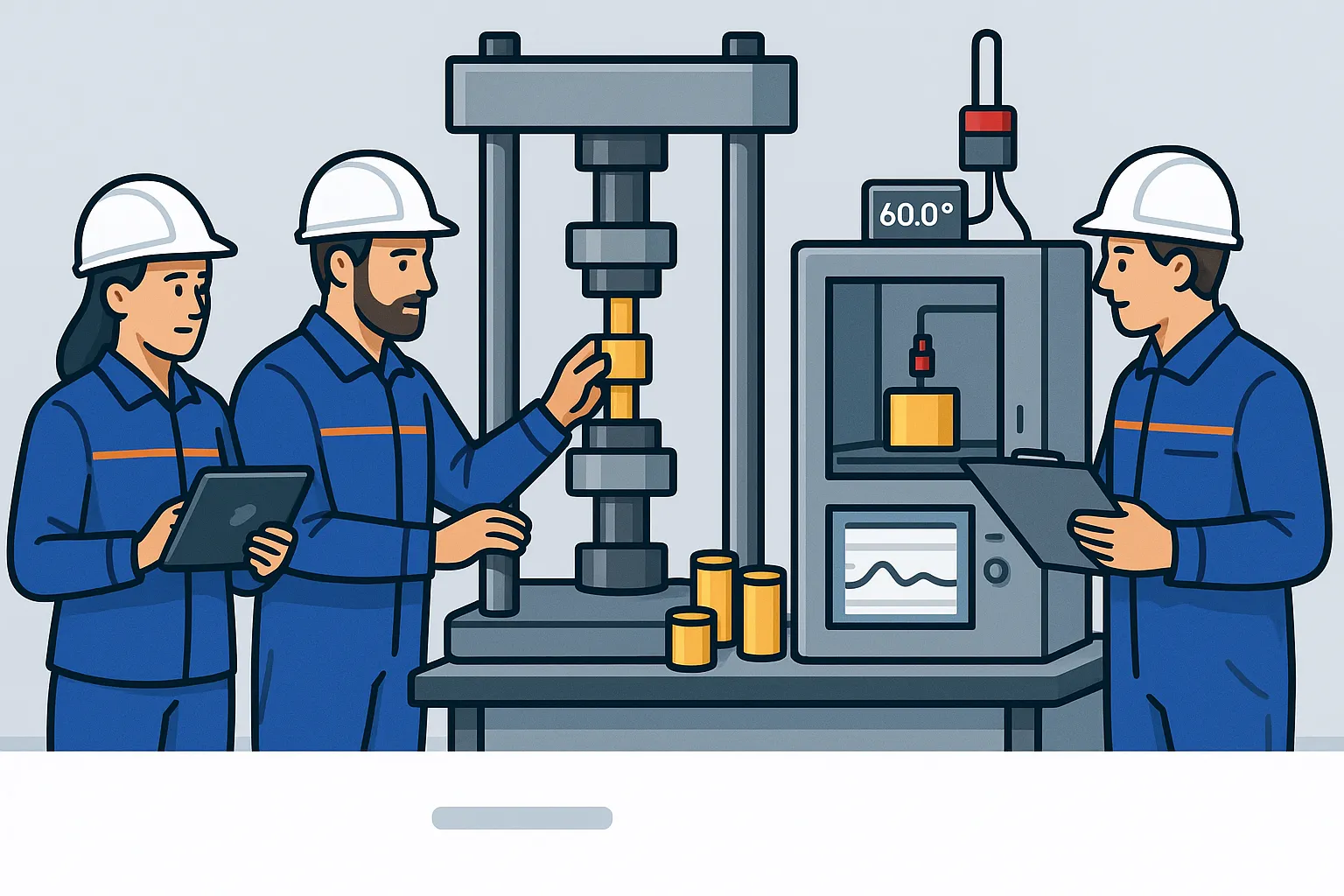
The method is used for slab polymers, foam plastics, plastics, and structural thermosetting agents.
When testing thermoplastics, it is important to maintain a constant temperature - use a heat chamber heated to +80°C to obtain accurate results.
- Standard: GOST 4651-2014, ISO 604
- Measured: compressive strength, elastic modulus
Bend (three-point or four-point)
Allows you to evaluate the resistance of a material to deformation under static load.
- Standard: GOST 4648-2014, ISO 178, ASTM D790
- Important: GOST 5686, mentioned in some sources, is not applicable - it is for pile tests in soils.
Impact strength
The test is carried out on a pendulum pile driver. The notched sample is destroyed by impact.
- Standard: GOST 4647-2015, ISO 179, ASTM D256
- Methods: Charpy and Izod
Shore hardness
Used for elastomers, sealants, silicones. Indentation resistance indicator.
- Standard: GOST 24621-2015, ISO 868
- Types of scales: A, D (for soft and hard materials respectively)
- Equipment: hardness tester with digital head, adherence to reading time (standard – 3 s)
Abrasion
For floor coverings, tires, gaskets and other products operating under friction conditions.
- Method: loss of mass/volume after a given number of revolutions of the abrasive wheel.
- Standards: GOST 263–75, ISO 4649, ASTM D5963
Non-destructive testing (NDT) methods for polymers and composites
Although polymers are primarily tested by destructive methods, there are a number of situations where NDT methods, especially for composite And layered structures.
NDT methods used:
| Method | Description and scope | Standards |
|---|---|---|
| Visual and measuring | Surface defects, geometry deviations | GOST 3242–79 |
| X-ray control (CT) | Internal inclusions, pores, delaminations in composites | GOST R 56787, ASTM D229 |
| Sherography | Interference method for laminated panels (including aircraft composites) | GOST R 56787-2015 |
| Thermal analysis, thermal imaging | Identification of areas of uneven curing, cracks, voids | ISO 18436, ASTM E2582 |
🧠 Example: when inspecting fiberglass wind turbine blades, shearography allows you to quickly identify areas with potential delamination and unstable structure.
Selection of equipment: universal machines, pile drivers, hardness testers

Equipment for testing polymers can be universal or specialized. The main types are listed below:
Modern universal testing machines provide ±1% accuracy and automatic data transfer to LIMS systems via API, which significantly speeds up the protocol preparation process.
1. Universal testing machines (UTM)
They are used for stretching, compression, bending, and shear.
- Load capacity: from 1 kN (miniature samples) to 100 kN (reinforcing bars)
- Control: manual, semi-automatic, from PC via software
- Verification: according to GOST ISO 7500-1-2022
- Grips: wedge, eccentric, pneumatic
- Examples of manufacturers: Instron, Zwick/Roell, Tonus, PMT
💡 Tip: for elastomers, pneumatic grips with a long stroke are preferable; for reinforced thermosets, rigid wedge grips are preferred.
2. Pendulum pile drivers
For impact tests.
- Types: pendulum with fixed impact energy (Charpy, Izod)
- Precision: digital copters with programmable reset and automatic viscosity calculation
3. Shore hardness testers
- Modifications: manual, electronic, tabletop
- Protocol support: automatic data transfer to LIMS via USB/RS-232
Automation and digital technologies
A modern laboratory must not only be accurate, but also digital. This applies to both data collection and storage and equipment management.
LIMS and API systems
- LIMS (Laboratory Information Management System) — centralized software for storing protocols, tracing samples, planning and testing equipment.
- Implementation: based on 1C, or third-party solutions
- Integration protocol: ASTM E1382-15, OPC UA, JSON/XML API
🖥️ Example: The LIMS system receives data directly from the UIM, draws up a PDF protocol and sends it for approval to ERP without the participation of an engineer.
Video extensometers and DIC
Non-contact methods for monitoring movement and deformation have become the standard.
- Technology: DIC (Digital Image Correlation)
- Description: matching sequential images to measure deformations
- Application: reinforced composites, thermoplastics, soft materials
- Precision: up to 1 micron on an area of 100×100 mm
📸 Example: When testing glass fabric for interlayer shear, DIC allows you to visualize the onset of delamination before the machine detects it.
Examples of integration in practice
- Polyethylene pipe plant (Moscow): switched to testing according to GOST ISO 527-1, integration with LIMS, reducing protocol time by 40%.
- Geosynthetics Laboratory (Kazan): conversion from GOST 30435-97 to GOST 32491-2013, automatic transfer of results to the Ministry of Construction via API.
- Research Institute of Aviation Materials: DIC and shearography are used to test CFRP panels, each sample is marked with a QR code and linked to a LIMS database.
Testing of composite polymer materials
Composite materials (fiber-reinforced polymers) are a separate category that requires special techniques.
Features of composites:
- Anisotropic structure → different characteristics along and across the fibers.
- Layers → delamination and delamination are possible.
- Increased requirements for quality control.
Test methods:
| Property | Method | Standard |
|---|---|---|
| Bend | 3-point | ASTM D790 |
| Interlayer shear | Short sample | ASTM D2344 |
| Fatigue strength | Cyclic loading | ASTM D3479 |
| Delamination (layer rupture) | Mode I/II methods | ASTM D5528, ISO 15024 |
Sample preparation:
- Precision milling, embedded elements, fiber control
- Climatic exposure required (23±2°C, 50±5% RH)
- For aviation - mandatory NDT after testing
📌 Example: When testing carbon fiber reinforced plastic spars, DIC systems and ultrasound are used before and after mechanical impact.
Testing geosynthetics: old and new GOST
Testing of geotextiles and geogrids remains key in the construction of roads, bridges, and waterproofing. Previously, GOST 30435-97 was used, but it outdated.
Current standards:
- [GOST 32491-2013](https://docs.cntd.ru/document/1200103945) (equivalent to EN ISO 10319): wide band stretch method
- GOST R 53225/53226-2008 – geogrids
- ISO 13426-2 – CBR penetration
- ISO 9863-1 - thickness under load
📏 Equipment: UIM with roller grippers, sample width 200 mm, length 300 mm. Temperature control. Periodic calibration check.
Comparison of international standards (ISO, ASTM, GOST)
| Test type | GOST | ISO | ASTM |
|---|---|---|---|
| Bend | GOST 4648 | ISO 178 | ASTM D790 |
| Hit | GOST 4647 | ISO 179 | ASTM D256 |
| Hardness | GOST 24621 | ISO 868 | ASTM D2240 |
| Geotextiles | GOST 32491 | ISO 10319 | ASTM D4595 |
| Compression | GOST 4651 | ISO 604 | ASTM D695 |
🧩 Conclusion: when choosing equipment, it is better to focus on international methods - ISO or ASTM, if the products are exported or the materials are foreign.
Glossary (terms and abbreviations)
- UIM – universal testing machine
- DIC – digital image correlation (optical tracking of deformations)
- LIMS – Laboratory Information Management System
- NK – non-destructive testing
- CBR – California Bearing Ratio, penetration method
- GOST ISO – harmonized GOST, identical to international ISO
- ASTM – American Society for Testing and Materials
Frequently asked questions (FAQ)
Which GOST should I choose for tensile testing of rubber?
Use [GOST ISO 37-2020](https://docs.cntd.ru/document/1200172044) is a harmonized standard identical to ISO 37:2017. It replaces GOST 270-84 and is applicable for rubbers with different hardnesses. An example of equipment is a UIM with grippers for ring or rectangular samples.
Is it possible to use non-destructive testing for geomembranes?
Yes. For example, when welding polyethylene geomembranes on a construction site, ultrasonic testing, method with a vacuum chamber or radiography of seams - in accordance with GOST R 56787-2015 and ISO standards.
What to consider when choosing laboratory equipment?
- Availability of verification according to GOST ISO 7500-1
- Possibility of connecting a video extensometer
- Interfaces for integration (USB, Ethernet, API, OPC-UA)
- Support for automatic data upload to LIMS
- Software with protocols in Russian
- Availability of service support and calibration in the Russian Federation
What tests are required for geotextiles?
According to GOST 32491-2013 and ISO 10319: wide belt tensile test, CBR puncture, thickness measurement, water permeability. For bridges and roads, long-term strength is added (ISO 13431).
Conclusion
Testing polymer materials is no longer just a formality, but key to asset longevity, risk reduction and compliance. From geotextiles under road surfaces to reinforced composites in aviation, everything goes through laboratory testing.
Today, not only GOST is important, but also how exactly do you implement standards: do you use automation, do you comply with the latest versions of ISO, do you maintain a digital protocol.
CTA: Where to buy laboratory equipment for polymer testing?
On our marketplace you can buy laboratory equipment for testing polymers, including:
- Universal testing machines
- Pendulum pile drivers
- Shore hardness testers
- Video extensometers DIC
- NDT complexes (ultrasound, shearography)
- Laboratory software and LIMS systems
📞 Contact us to select equipment for your GOST or ISO - we will select a kit for your tasks and budget.
{/ Images for the article (5 pieces) /}