
Introduction
My name is Alexey Ignatiev, I am the chief engineer of the mechanical testing laboratory at Mattest. Over 17 years of work in the field of quality control of building materials, I have become convinced of: laboratory tests is the basis for the safety and durability of any construction project.
Laboratory testing of building materials represent a set of methods that make it possible to determine the compliance of materials and structures with the requirements of regulatory documents. LLC "MATTEST" offers a full range laboratory tests for building materials and structures in accordance with Russian GOST standards and other regulatory documents.
Modern requirements for construction quality make laboratory control a mandatory element of the construction process. Properly carried out testing of building materials guarantee compliance of structures with design characteristics and ensure safe operation of facilities.

1. Testing crushed stone and gravel (aggregates)
Regulatory framework
Crushed stone tests carried out in accordance with GOST 8269.0-97 "Crushed stone and gravel from dense rocks and industrial waste for construction work - Methods of physical and mechanical testing." Additionally applicable GOST 32703-2014 "Public roads. Crushed stone and gravel from rocks. Technical requirements."
Dense rock crushed stone used in construction (e.g. road base, concrete aggregate) must meet strict quality criteria.
Main types of testing of aggregates
Sample preparation includes drying and preparation of aggregate samples for testing (removal of small particles, quartering, etc.). Proper sample preparation ensures that test results such as sieve analysis or strength determination are representative.
Particle size distribution (sieve analysis) — determination of particle size distribution by sifting the aggregate through a standard set of sieves. This provides a particle size distribution and fineness modulus that indicates whether the aggregate meets the size requirements. GOST 8269.0 includes methods for analyzing grain composition.
Correct aggregate grading is critical to producing quality concrete with the required strength and workability characteristics.
Compressive strength (crushability) in dry and water-saturated conditions — measurement of aggregate resistance to crushing under load. In a dry state, the aggregate is tested for strength; In the water-saturated state, the test evaluates durability in wet conditions. GOST 8269.0 defines the procedure for determining crushability in both states. High-quality aggregates show low crushing under standard loads.
Abrasion in shelf drum — testing the wear resistance of the aggregate using a rotating drum with shelves (Deval or Micro-Deval method). The stone sample is mixed and the degree of wear (mass loss) is measured. This models wear and tear from traffic or handling. Quality aggregates show low wear in this test.
Frost resistance (accelerated freezing-thawing) - an accelerated method for determining the number of freeze-thaw cycles that a filler can withstand before significant loss of strength. GOST 8269.0 provides for accelerated frost resistance testing (usually up to 15 or 25 cycles for standard, and up to 50 cycles for increased requirements). MATTEST offers testing up to 50 cycles, indicating resistance to harsh climate conditions.

2. Testing sand (construction sand)
Standard: GOST 8735-88
Construction sand (used as fine aggregate in concrete, mortar and other works) is tested according to GOST 8735-88 "Sand for construction work. Test methods."
Key Sand Tests
Sample preparation and humidity - The sand sample is dried and prepared. Natural moisture content can be determined by weighing before and after drying. This affects the volumetric weight of sand and is necessary when calculating the composition of concrete mixtures.
Particle size distribution and fineness modulus — sieve analysis is carried out to determine the size distribution of sand particles. The results classify the sand (coarse, medium, fine) and calculate the fineness modulus - a single number indicating the size of the sand. The correct size ensures good workability and strength of the concrete/mortar.
Maximum dry density at optimum humidity (Proctor test) — determination of the compaction characteristics of sand (especially for use as backfill or base). The sand is compacted at various moisture contents to determine the optimum moisture content and corresponding maximum dry density. This is carried out in accordance with GOST 22733. Helps in excavation work to ensure proper compaction of the sand backfill or sub-base to the required density.
The quality of sand directly affects the strength and durability of concrete and mortar mixtures. Poor quality sand can reduce the strength of concrete by 15-20%.
3. Testing of fresh concrete and mortar mixtures
Regulatory Standards
Fresh concrete testing regulated GOST 10181-2014 "Concrete mixtures. Test methods", GOST 7473-2010, GOST 27006-86 "Concrete. Rules for the selection of compositions" and GOST 5802-86.
Test methods for fresh mixtures
Workability (consistency) - Measurements such as cone slump or table spread are taken to determine the ease of placing and compacting the concrete mixture. GOST 10181 covers methods for determining workability (slump, spread, etc.), which is critical to ensure correct placement of the mixture.
Density and air content - the density (volumetric weight) of the fresh mixture is measured, and from it the air content can be determined if required by the project (important for frost resistance). GOST 10181 provides methods for average density and porosity of the mixture.
Temperature and setting (keeping quality) — the temperature of fresh concrete is measured (especially when concreting in hot/cold weather). The standard also covers testing how long the mixture remains workable (setting time or workability retention).
Making samples for strength testing — MATTEST can produce standard test samples from fresh mixture: for example, 10x10x10 cm cubes (or cylinders). The service "Production of samples 10×10×10" includes filling molds and hardening to obtain samples for subsequent strength tests (according to GOST 10180).

Selection of concrete mixture composition - a specialized service for selecting (dosing) the composition of a concrete mixture to meet certain requirements (for example, strength, water resistance W4, frost resistance F75). Using rules GOST 27006-86, the laboratory can develop the optimal composition of the mixture.
The process involves calculating the ratio of cement, water, aggregates and additives to achieve target workability and strength while minimizing cost. MATTEST offers two levels: (a) use of known material properties, or (b) comprehensive design, including testing of all raw materials before design.
4. Testing of hardened concrete
Concrete Test Standards
Testing of hardened concrete are carried out according to GOST 10180-2012 "Concrete. Methods for determining strength using control samples", GOST 22690-2015 "Concrete. Determination of strength by mechanical methods of non-destructive testing" and GOST 28570-2019 "Concrete. Methods for determining the strength of samples taken from structures."
Basic test methods
Compressive strength of cubes/cylinders - standard cubes (for example, 7x7x7 cm, 10x10x10 cm) are crushed in a press to measure compressive strength according to GOST 10180. This determines the class of concrete (for example, B25, B30, etc.). The laboratory may test samples made from concrete from the site or cores drilled from structures.
Waterproof - a concrete waterproof test (often designated W2, W4, etc.) involves placing a 15x15x15cm cube in a special apparatus that exposes one face to water under increasing pressure until seepage is observed. The Waterproof Test service measures the maximum pressure that concrete can withstand without water penetration.
Non-destructive strength testing — MATTEST offers NDT methods such as rebound hammer (Schmidt hammer) and ultrasonic pulse velocity to evaluate the strength of concrete in-situ without damaging the structure. GOST 22690-2015 describes combined methods (for example, shock-pulse (rebound) and ultrasonic methods) for indirectly determining the strength of concrete.
Correlations (calibration curves) are commonly used. This service is useful for assessing existing structures: for 1-100 points on a structure, technicians can quickly assess strength uniformity. According to GOST 22690, both ultrasonic impulse velocity and rebound number are often measured and then converted to strength using an empirical formula.
Combined non-destructive testing methods increase the accuracy of concrete strength assessment by 25-30% compared to single measurement methods.
Core sampling and testing — when precise strength is required from an existing structure, cores are drilled. GOST 28570-2019 covers testing procedures for cores cut from hardened concrete. MATTEST can extract cores (usually 70-100mm in diameter) and test them under compression.

5. Soil testing and soil classification
Regulatory framework
Understanding soil properties is essential for excavation and foundation construction. GOST 25100-2011 "Soils. Classification" is the main standard for naming and classifying soils in Russia.
Laboratory soil testing
Sample preparation, humidity and quartering - soil samples are prepared by air drying (or maintaining natural moisture if necessary), then the natural moisture content is measured (by drying the part at 105°C). Quartering (dividing into representative subsamples) is performed to obtain the test part.
Granulometric analysis (sieve and hydrometric) — determination of the size distribution of soil particles: for large fractions sieving is used; for small fractions (silt, clay), sedimentation (areometric) analysis can be carried out according to GOST 12536 "Soils. Methods of laboratory granulometric analysis."
The resulting particle size distribution curve allows classification (e.g. sand, loam, clay) according to GOST 25100. For example, a soil with >50% sand-sized particles may be classified as sandy soil, while a high clay content classifies it as clayey.
Atterberg Limits (if necessary) — Clay consistency tests (yield stress, plastic limit) are often carried out to classify fine soils. GOST 25100 uses these indices to distinguish clay from loam.
Proctor compaction (maximum density at optimum humidity) - This test determines the maximum dry density that the soil can achieve and the optimum moisture content for compaction, following GOST 22733. The soil is compacted in a mold with a standard force at various moisture levels to produce a compaction curve.
6. Field testing of density and static probing
Standards and Guidelines
To control the quality of earthworks (foundation pits, road beds, backfilling of trenches), field tests are carried out in accordance with GOST 20522 for density using the cutting ring method and ODM 218.5.007-2016 for static probing.
Field test methods
In-situ density determination using the cutting ring method - a metal cutting ring of known volume is pressed into the soil or compacted layer to extract a soil sample. The sample is weighed and dried, allowing field bulk density and moisture content to be calculated. Comparing this to the maximum Proctor density gives the degree of compaction achieved (often reported as ≥ 0.95 of Proctor).
Static stamp probing (strain modulus) - to assess the bearing capacity and deformation characteristics of the subgrade or foundation soil, MATTEST carries out punch tests using a round steel plate (usually 300 mm in diameter) loaded with a hydraulic jack up to 100 kN according to the guidelines ODM 218.5.007-2016.
The test measures plate settlement under each load increment and after unloading. From this the elastic deformation modulus (Ev₁, Ev₂) is derived. According to the Russian road method, two loading cycles are performed and the Ev₂/Ev₁ ratio indicates the quality of the compaction.
Field testing complements laboratory testing by assessing the actual conditions of the constructed facility. A high degree of compaction and a satisfactory modulus from static sounding mean that the excavation work has been carried out correctly.

7. Testing of asphalt concrete and asphalt mixtures
Standards for asphalt concrete
MATTEST is also testing asphalt concrete and asphalt mixtures, which is critical for the quality of the road surface. GOST 12801-98 "Materials based on organic binders for road and airfield construction. Test methods" provides general methods for testing asphalt materials.
The GOST R 58406.x and GOST R 58401.x series (2019-2020) have recently been introduced, aligned with international standards for asphalt mixture specifications and test methods.
Key Asphalt Concrete Services
Selection of cores from coatings — MATTEST can extract asphalt cores (typically 100mm in diameter) from existing road surfaces. The service "Sampling (cores) from the coating" includes drilling cylindrical samples of the asphalt layer. These cores are used to evaluate layer thickness, compaction (density) and further laboratory testing.
Comprehensive testing of asphalt concrete — "comprehensive testing of asphalt concrete" covers the full range of tests on a sample or mixture of asphalt concrete, often required for type approval or quality control. Typically includes:
- Bulk density and void content — determination of the compacted density of asphalt and calculation of the percentage of air voids
- Stability and fluidity according to Marshall - measurement of the load (stability) that an asphalt sample can bear at 60°C, and the deformation (yield) under load
- Bitumen content (binder) - extraction and measurement of asphalt binder content to ensure the correct percentage of binder in the mixture
- Granulometric composition of the mineral mixture - sieve analysis of aggregate extracted from asphalt to verify grading compliance with requirements
- Water resistance — testing the resistance of the asphalt mixture to water damage
8. Testing of steel reinforcement and metals
Standard: GOST 12004-81
For reinforced concrete construction steel reinforcement must be tested to verify its mechanical properties. MATTEST tests reinforcing steel according to GOST 12004-81 "Reinforcing steel. Tensile testing methods."
Test methods for fittings
Tensile testing of reinforcement — reinforcement samples (steel bars) of various diameters are stretched to failure in a tensile testing machine under standard conditions of +20°C. GOST 12004 defines the methodology for reinforcement with diameters from 3 mm to 80 mm, including gripping methods and elongation measurement.
Results measured: yield strength (or 0.2% proof strength for some steels), tensile strength, elongation at break, and area contraction. For quality control, a batch of reinforcement is usually tested (for example, 3 samples), and the results are compared with the requirements of the steel class.
Geometric parameters of reinforcement — measurement of reinforcement dimensions: nominal diameter, corrugation geometry (height, pitch) and weight per meter. This ensures that the reinforcement meets dimensional tolerances (important for mechanical adhesion to concrete).
Tensile testing of reinforcement according to GOST 12004 is a fundamental safety test, since structural integrity depends on the performance of the reinforcement under tension.

9. Masonry materials: bricks, blocks, stones, border elements
Applicable GOSTs
MATTEST services for masonry and concrete products ensure that these products comply with relevant quality standards in accordance with GOST 530-2012 for bricks, GOST 6133 for paving slabs and others.
Types of testing of masonry materials
Visual inspection and dimensions - checking the appearance and size of bricks, blocks or tiles. The standards require that products be within tolerances for length/width/height and be free from major cracks or chips on visible edges.
Compressive/flexural strength (breaking load) — determination of the load that a product can withstand before failure:
- Bricks/blocks: usually tested in compression to determine compressive strength (for example, grade M100, M150 in kgf/cm²)
- Curb stones, concrete slabs: Flexural (transverse) strength is often tested, especially for concrete pavements or curbs
Frost resistance — Many masonry products must withstand freeze-thaw cycles without significant damage. The service “frost resistance by basic method” indicates a freeze-thaw test using the basic (standard) method. For bricks, this usually means saturating the samples and freezing/thawing them for a certain number of cycles (e.g. F15, F25, F50 depending on the brand).
10. Testing of fasteners and anchors (pull-out tests)
Standard: GOST 8829-94
This category covers full-scale testing of anchors, fasteners and fastenings in concrete or masonry to assess their pull-out strength, as well as testing of building envelopes in accordance with GOST 8829-94 "Concrete and reinforced concrete prefabricated products. Load test methods."
Test methods
Anchor pull-out test — анкеры (механические или химические анкеры, распорные болты и т.д.), встроенные в бетон или кладку, испытываются приложением растягивающей нагрузки до их выдергивания или достижения определенной пробной нагрузки. The MATTEST service typically includes in situ testing of a batch (eg 10 anchors).
The procedure, as prescribed by GOST 8829, consists of applying a load in steps of about 10% of the expected breaking load, with each step held for a short time. After each increment, a complete unload is performed to check the residual movement.
Testing of protective/enclosing structures - This probably refers to the testing of railings, handrails, parapets or other protective barriers by applying loads to check their strength and fastening. For example, building codes require balcony railings to withstand a horizontal load (e.g. 0.3 kN/m).
Full-scale load testing is critical for safety validation. Anchors, especially those installed after concreting, can vary in performance due to the quality of installation or differences in the base material.
11. Field surveys: testing piles for integrity and expert consultations
Specialized field services
MATTEST also offers specialized field services, which include sending experts to the site:
Testing piles for integrity using the low voltage method (seismoacoustic method) - This non-destructive testing checks bored concrete piles for defects (such as cracks, narrowings, voids) along their length. Often called a sound echo or shock-echo test.
The specialist hits the top of the pile with a hand hammer with a sensor; the stress wave travels down the pile and is reflected back from the heel or any defect. By analyzing the echo, pile length and continuity can be assessed.
Specialist visits - Travel services to specific areas indicate that MATTEST can dispatch engineers or technicians to conduct field sampling, testing or consulting. This may include taking cubes of concrete/mortar on site, taking soil samples, field testing or simply advising on construction quality issues.

12. Testing of paint and varnish coatings (thickness and adhesion)
Coating Standards
The quality of protective paints and coatings on metal structures is critical to corrosion protection. MATTEST carries out full-scale or laboratory assessment of coatings according to GOST 31149-2014 (ISO 2409 for lattice cut), possibly GOST 32299 / ISO 4624 for peel-off adhesion.
Coating test methods
Dry film thickness measurement - Using electromagnetic or ultrasonic thickness gauges, the technician measures the thickness of the paint layer on metal substrates. The service is often quoted per area or per number of locations. Ensuring coating thickness meets specifications (eg 150 microns for a heavy duty anti-corrosion system) is vital.
Adhesion (tear-off method) - This test evaluates how well the coating bonds to the substrate. MATTEST uses the normal peel method: a loading puck is glued to the paint surface, and after the adhesive has cured, a handheld adhesion tester is used to pry the puck perpendicular to the surface until the coating is released.
The result is usually reported in MPa or psi - indicating the tensile adhesion strength of the coating. Higher peel strength means better adhesion. Additionally, the failure mode is observed: whether the coating has detached from the metal (adhesive failure) or torn within the layer (cohesive failure).
Through these tests, MATTEST verifies that coatings are applied to the correct thickness and adhere properly to the substrate. Adequate thickness provides the expected barrier protection, and strong adhesion means the coating will not peel off prematurely.
13. Non-destructive testing of welded joints and metal structures
Full range of NDT methods
MATTEST offers a full range of services non-destructive testing (NDT) for welded joints and metal structures that are critical for detecting defects without damaging components:
Visual and measuring control (VC) — trained inspectors visually inspect welded joints and structural elements, often using measuring tools (fillet weld templates, magnifying glasses). They check surface defects (cracks, pores, undercuts, etc.), seam dimensions and compliance with the design.
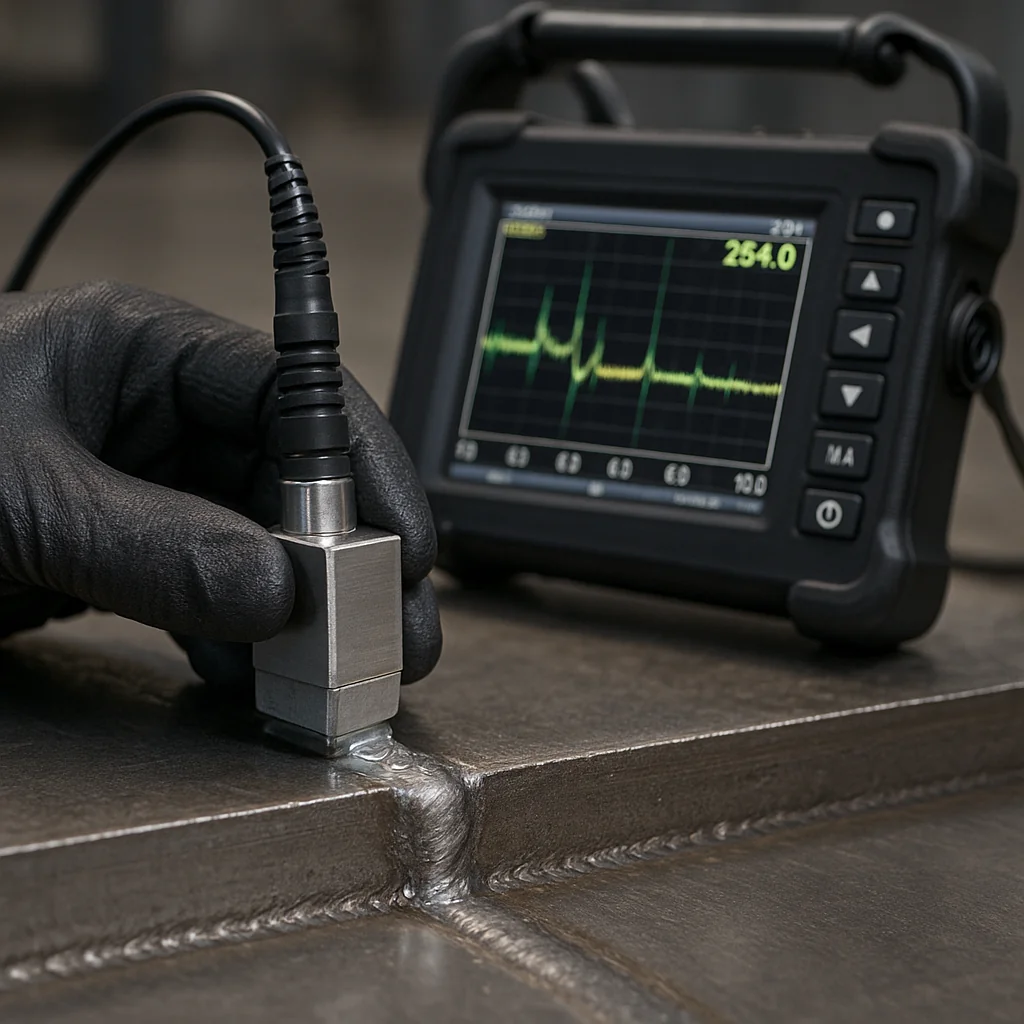
Ultrasonic testing of welded joints (UC) — using ultrasonic flaw detectors, MATTEST can check welded joints for internal defects, such as lack of fusion, cracks, slag inclusions, etc. The CC involves sending high-frequency sound waves into the weld through a sensor; reflections from defects are captured and analyzed.
GOST 14782-86 "Welded joints. Ultrasonic testing methods" regulates this test. According to GOST 14782, the Criminal Code is applicable to butt, T, and corner joints in metal usually ≥ 8-10 mm thick.
Ultrasonic thickness gauging — measuring metal thickness using ultrasonic pulses (especially for examining corrosion of pipes, tanks, etc.). The thickness gauging service covers checking the thickness of metal at certain points or areas.
Radiographic testing (RC) of welded joints — the use of x-ray or gamma radiation to detect internal defects in welded joints and castings. MATTEST can conduct RK on:
- Small diameter pipelines (up to Ø28 mm, t ≤ 5 mm)
- Equipment and structures (thickness up to 5 mm per shot)
GOST 7512-82 "Welded joints. Radiographic method" is the classic standard for this. It determines how to expose and evaluate radiograms: sensitivity and acceptable defect sizes.
Penetrant control (CC) - a method for detecting surface defects (cracks, lack of fusion, open to the surface) on welded joints or metal surfaces, using the capillary action of liquids. MATTEST offers QC for:
- Small diameter pipes (Ø ≤ 28 mm, t ≤ 5 mm)
- Welded joints on structures (flat or curved) in various orientations
The method involves cleaning the weld, applying a liquid penetrant dye that seeps into the cracks, then after a dwell time, cleaning the surface and applying a white developer. The red dye that has been trapped in the cracks protrudes, forming visible indications on the white background.
Using these NDT techniques, MATTEST helps ensure that welded structures are free of dangerous defects that could lead to failure. Each method has its strengths: VC finds visible defects and dimensional problems; CC finds internal planar defects; RK provides a permanent image of internal volumetric defects; CC finds narrow surface cracks.
Modern technologies in laboratory testing
Automation of control processes
Modern laboratory tests are becoming increasingly automated. Automated systems provide:
- Automatic installation and positioning of samples
- Programmable loading and unloading cycles
- Automatic determination of the moment of sample failure
- Generation of protocols and reports without operator participation
Digitalization of laboratory processes
Digital laboratories integrate modern information technologies:
- Tamper-proof electronic test logs
- Automatic data transfer from measuring instruments
- Statistical processing of results in real time
- Integration with corporate quality management systems
Remote test monitoring
Modern systems allow:
- Remote monitoring of test progress
- Receive notifications when tests are completed
- Access to results via web interface
- Video recording of critical tests

Quality assurance and metrological support
Laboratory accreditation
Accredited laboratories must meet the requirements:
- GOST ISO/IEC 17025 "General requirements for the competence of testing and calibration laboratories"
- Regular internal audits of the quality system
- Participation in interlaboratory comparison tests
- Continuous professional development of personnel
Calibration and verification of equipment
Metrological support includes:
- Primary verification when commissioning equipment
- Periodic verification with established frequency
- Extraordinary verification after repair or if a malfunction is suspected
- Maintaining metrological logs and equipment passports
Monitoring the stability of results
To ensure the reliability of the results, the following are used:
- Control samples with known characteristics
- Repeat tests to assess reproducibility
- Statistical control of measurement processes
- Trend analysis and identification of systematic errors
The laboratory's quality system must ensure traceability of test results to national standards and international standards.
Practical recommendations for choosing test methods
Test program planning
When planning laboratory tests consider:
- Test objectives: incoming control, production control, acceptance control
- Regulatory Requirements: mandatory and recommended tests
- Economic forces: test cost vs. risks from low-quality materials
- Time restrictions: deadlines for receiving results
Selecting the performing laboratory
Laboratory selection criteria:
- Accreditation for relevant types of tests
- Technical equipment modern equipment
- Personnel qualifications and work experience
- Geography locations and logistics capabilities
- Completion deadlines and cost of services
Preparation of samples for testing
The quality of the results depends on the correctness of:
- Sampling according to the requirements of the standards
- Marking and documentation samples
- Transportation and storage until testing
- Preparations for tests (conditioning, processing)
Economic aspects of laboratory testing
Cost of different types of tests
Price laboratory tests varies depending on:
| Type of test | Approximate cost | Due date |
|---|---|---|
| Strength of concrete (3 cubes) | 1,500 - 2,500 rub. | 28 days |
| Testing of fittings (3 samples) | 2,000 - 3,000 rub. | 1-2 days |
| Ultrasonic testing of welded joints | 500 - 800 rub./m | 1 day |
| Comprehensive soil testing | 8,000 - 12,000 rub. | 5-7 days |
Optimization of quality control costs
Ways to reduce costs:
- Group applications for testing similar materials
- Long-term contracts with laboratories on preferential terms
- Risk-based approach to test planning
- Using express methods for preliminary assessment
Economic effect of quality control
Investments in laboratory tests pays off due to:
- Preventing the use of low-quality materials
- Reducing the risk of accidents and structural damage
- Increasing the durability of construction projects
- Compliance with insurance company requirements
The cost of laboratory testing is usually 0.5-1.5% of the construction cost, but allows you to avoid losses 10-100 times higher than these costs.
Prospects for the development of laboratory testing
Introduction of new technologies
Future laboratory tests related to:
- Artificial intelligence to analyze test results
- Machine learning to predict material properties
- Blockchain technologies to protect test data
- Internet of Things for continuous monitoring of structures
Development of express methods
New express methods allow you to:
- Get test results in hours, not days
- Carry out tests directly on the construction site
- Reduce sample logistics costs
- Increase the volume of controlled parameters
Harmonization with international standards
Trends in the development of the regulatory framework:
- Adaptation of Russian GOSTs to ISO and EN requirements
- Mutual recognition of test results from different laboratories
- Unification of test methods for international trade
- Digitalization of regulatory documentation

Frequently asked questions (FAQ)
What documents are required for testing?
For laboratory tests usually required:
- Application for testing indicating the list of indicators to be determined
- Technical specifications or link to a regulatory document
- Accompanying documentation for the material (certificates, passports)
- Sampling report (if necessary)
How long do different types of tests take?
Completion deadlines testing of building materials:
- Express tests: 1-3 hours (humidity, density)
- Standard tests: 1-5 days (strength, granulometry)
- Long-term tests: 28 days (concrete strength at normal age)
- Special tests: up to 50 days (frost resistance of materials)
How to choose an accredited laboratory?
When choosing a laboratory, check:
- Availability of an accreditation certificate for the required types of tests
- Scope of accreditation and nomenclature of measurements
- Validity period of accreditation
- Reputation of the laboratory in the market
Can test results be challenged?
Test results can be challenged by:
- Carrying out repeated tests in the same laboratory
- Arbitration tests in an independent laboratory
- Appeals to the accreditation body when violations are identified
- Examination of the quality of tests performed
What is the accuracy of different test methods?
Accuracy of methods laboratory tests:
- Compressive strength of concrete: ±5% at confidence level 0.95
- Granulometric composition: ±2% for main fractions
- Density of materials: ±0.5% for standard conditions
- Non-destructive testing: ±10-15% depending on method
Conclusion
Laboratory testing of building materials is an integral part of modern construction, ensuring the safety, reliability and durability of construction projects. LLC "MATTEST" offers a full range of services for testing of building materials in accordance with Russian GOST standards and international requirements.
Properly organized system quality control materials allows:
- Ensure materials meet design requirements
- Prevent the use of low-quality materials
- Reduce the risks of accidents and premature destruction of structures
- Optimize costs for construction and operation of facilities
Technology development laboratory tests is following the path of automation, digitalization and integration with modern information systems. This improves accuracy, speeds up results, and improves the quality of decisions made.
Investments in quality laboratory tests is an investment in the safety and durability of construction projects. Saving on quality control of materials can lead to many times greater losses in the future.
When choosing a laboratory for testing of building materials pay attention to accreditation, technical equipment, personnel qualifications and reputation in the market. Only an integrated approach to quality control guarantees obtaining reliable results and making the right technical decisions.
For advice on choosing a laboratory testing program for your facility, contact MATTEST specialists. Our experience will help optimize costs and ensure the required quality of construction.