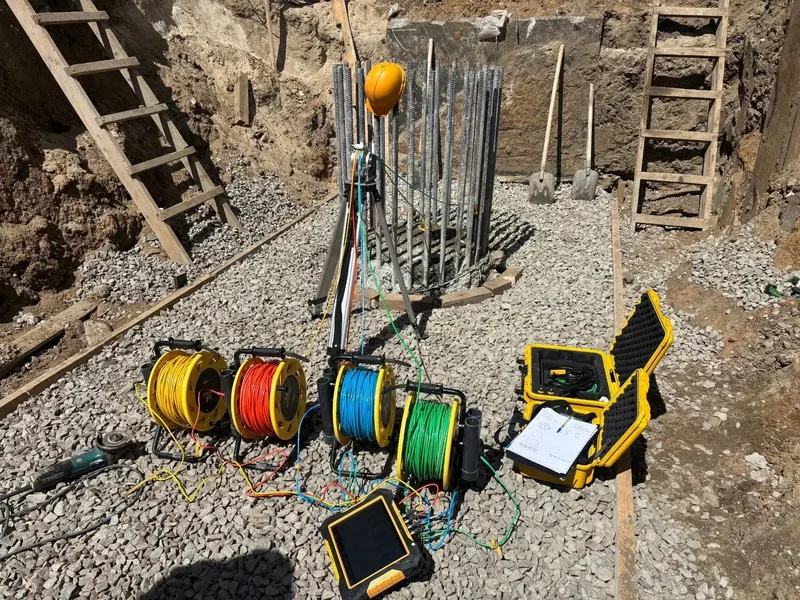

Why seismic-acoustic pile testing is needed
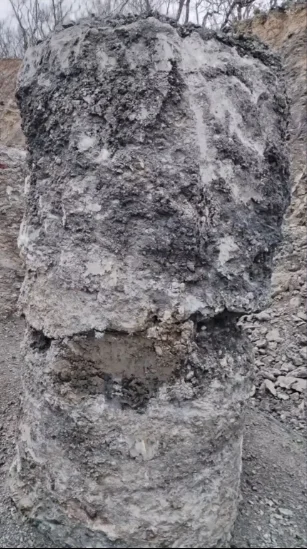
The construction of pile foundations involves quality control of the integrity (uniformity) of the pile concrete to detect impermissible defects in bored piles, for example: delamination, washout (leaching of the mortar component), cavities, "necks" (cross-section constrictions), "cold joints", foreign inclusions (soil intrusion) and "underdrilling" (insufficient length).
For inspection of bridge structures under SP 79.13330.2012, clause A.29 allows the use of the seismic-acoustic method for determining foundation parameters such as depth of embedment, thickness of the pile cap, etc.
SP 45.13330.2017 (clause 12.8) requires performing either full or selective quality control of the manufactured piles at the construction site. The scope of selective quality control includes verification of pile length and assessment of shaft integrity using seismic-acoustic testing on 20% of the total number of piles at the site.
In turn, SP 46.13330.2012 (bridges and pipes), in Table 6, indicates the need for ultrasonic pile testing and, where this is not feasible, allows the use of the seismic-acoustic method in the following volumes:
- every pile in capless supports;
- at least 30% of piles in a pile cap, but no fewer than 4 piles.
SP 412.1325800.2018 (for high-rise buildings), in clause 10.6.4 and Table 10.1, states that the scope of pile concrete quality control (length verification and assessment of concrete placement quality) must be at least 70% for piles with a diameter of 500 mm or more.
Regulatory framework for seismic-acoustic testing
Seismic-acoustic pile integrity testing is regulated by:
- GOST R 72171-2025;
- Technological Regulation on the application of non-destructive express integrity testing of piles by the "SONIK" method (JSC TsNIIS);
- PNST 804-2022 (withdrawn from 2026);
- STO EGEOS 1-1.2-001-2017 (EGEOS LLC);
- Guidelines on quality control of hidden works by geophysical methods during the construction of underground facilities, including metro facilities, in Moscow (Kapustin V. V., Churkin A. A., Vladov M. L., Nabatov V. V., Gaysin R. M., Nikolenko P. V.).
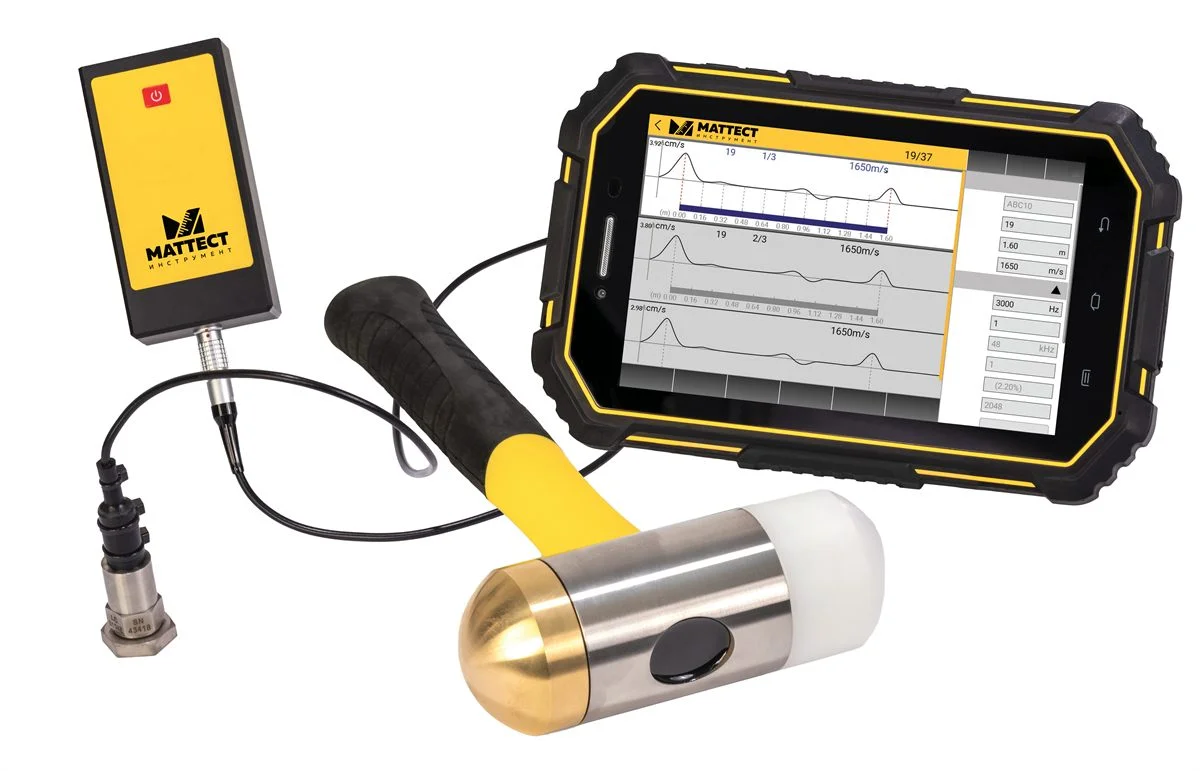
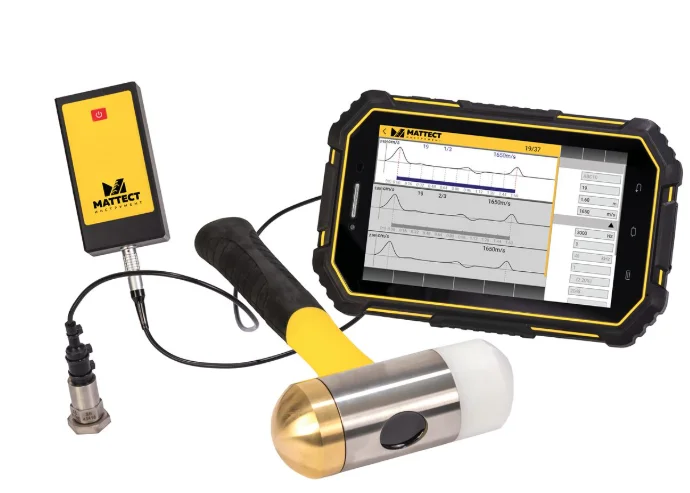
The MIT KIK instrument series consolidates the accumulated experience of the seismic-acoustic testing method. In this article we walk through the main stages of working with the MIT KIK 1-1K.
8 workflow stages with the MIT KIK 1-1K
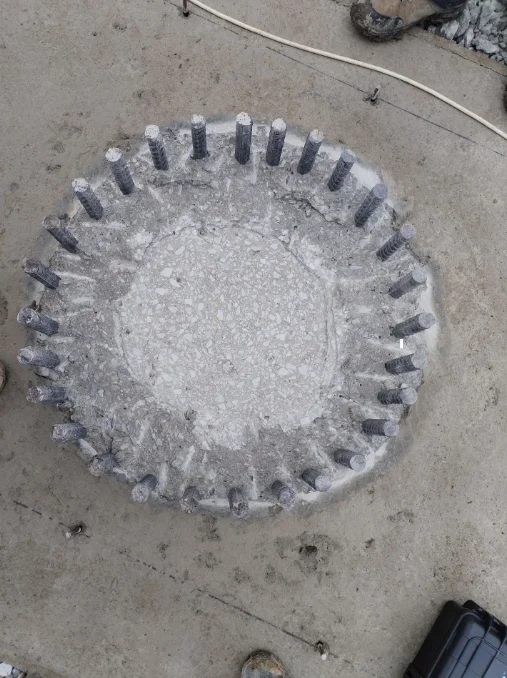
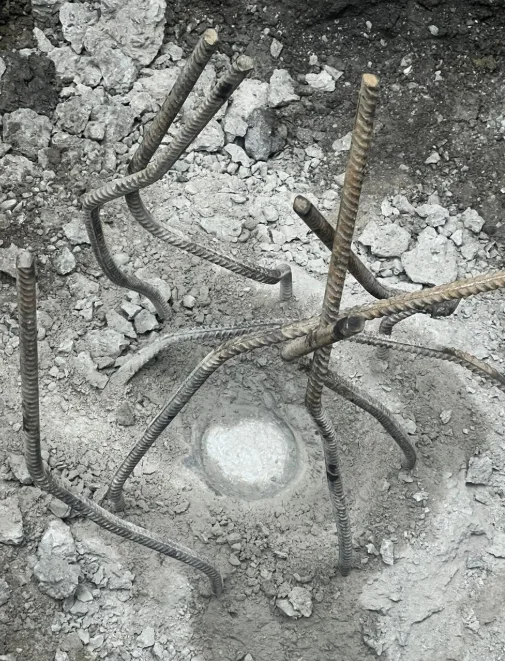
Preparing the pile head surface
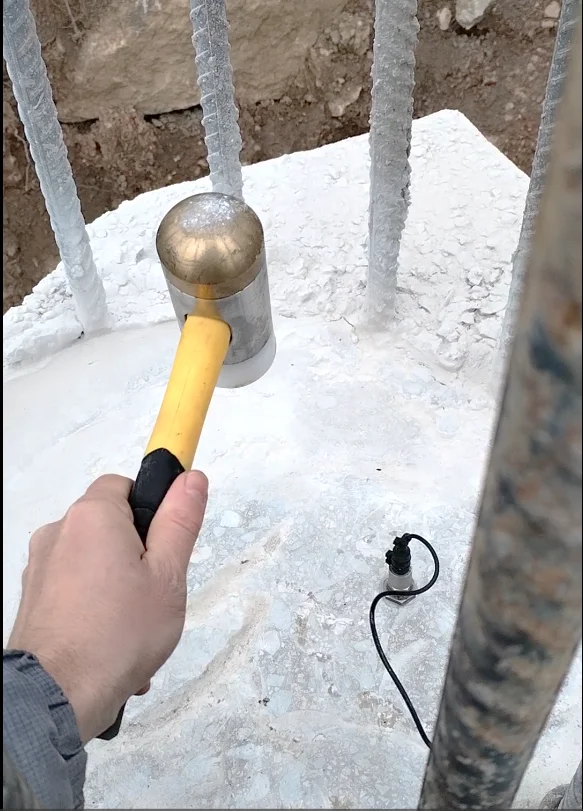
Preparation of the pile head involves levelling and grinding the surface areas where the receiver sensor will be installed and where the signal will be excited (i.e. where the impact will be delivered).
Installing the accelerometer sensor
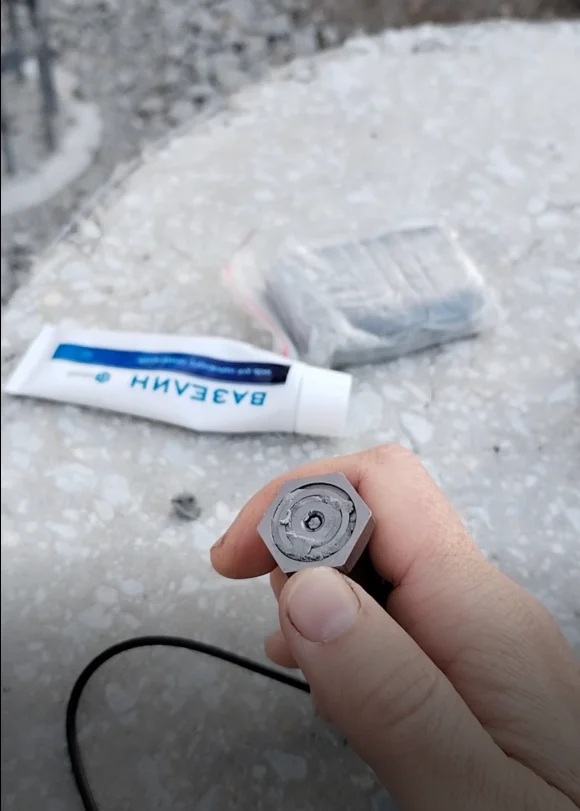
The sensor is installed at a distance of ½ radius from the pile centre.
Selecting the impact source
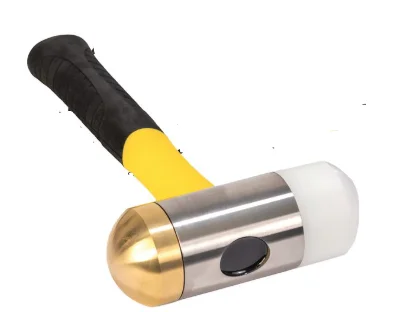
A hammer with metal and polymer hammer tips is used. The mass of the hammer and the material of the tip are selected based on the specific site conditions and the results of preliminary trial tests on site.
Preliminary instrument setup
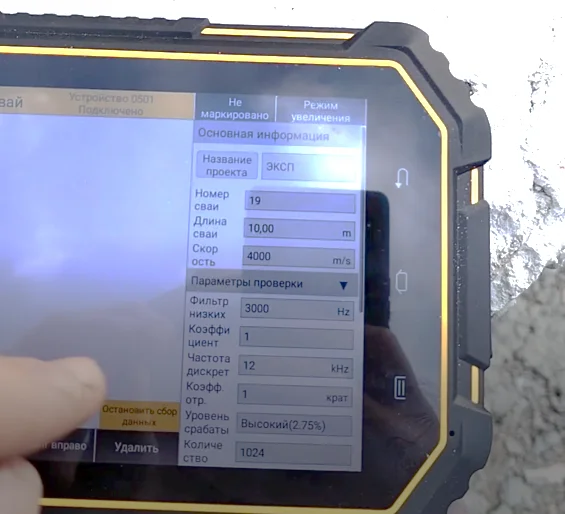
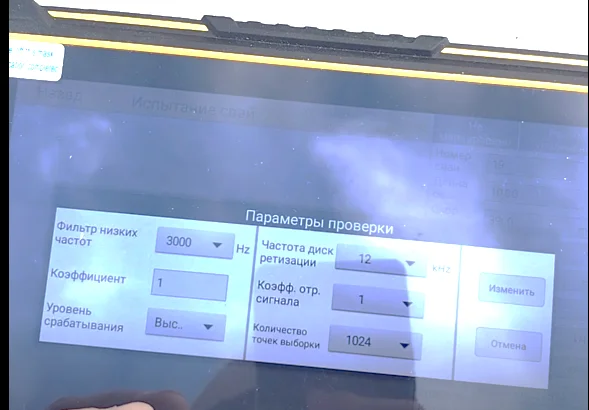
Setup of the MIT KIK 1-1K includes:
- entering information about the construction site and the pile under test (pile number, design length, concrete class, cross-section shape and dimensions);
- setting the bar velocity — either by choosing a value from the drop-down list or by entering it manually;
- configuring the high- and low-pass filters, and so on.
Delivering the impacts
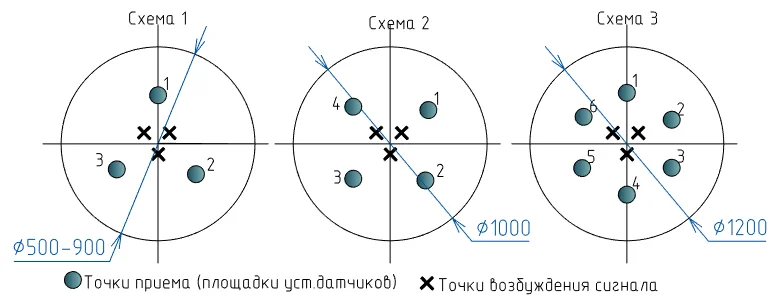
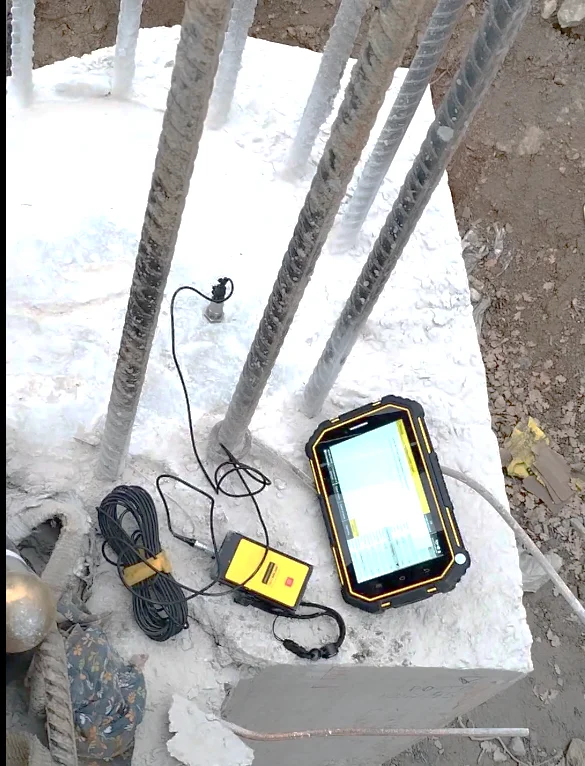
Impacts are delivered on the pads shown in Fig. 3. To obtain reliable test results, at least 12 impacts must be performed on a single pile; the best result is achieved when the number of impacts is at least 30.
For every 0.2 m² of pile head surface area, at least one sensor installation pad must be prepared. Each hammer impact on the pile must be a single strike — repeat blows after the first rebound are not allowed. The minimum time interval between individual impacts is determined by the time needed for the measurement unit to read and record the data.
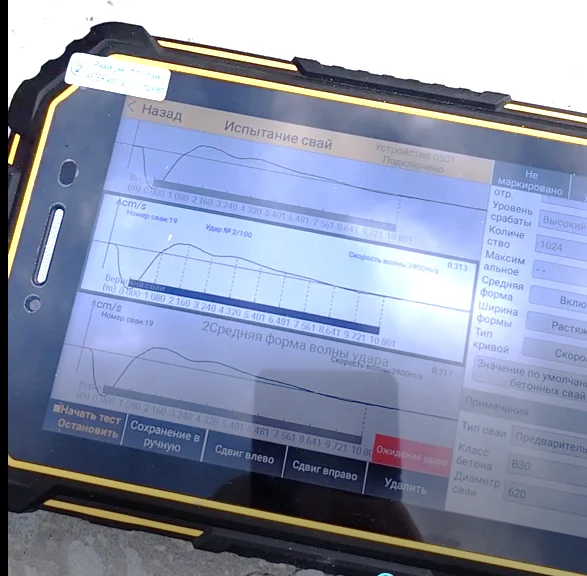
Acquiring reflectograms
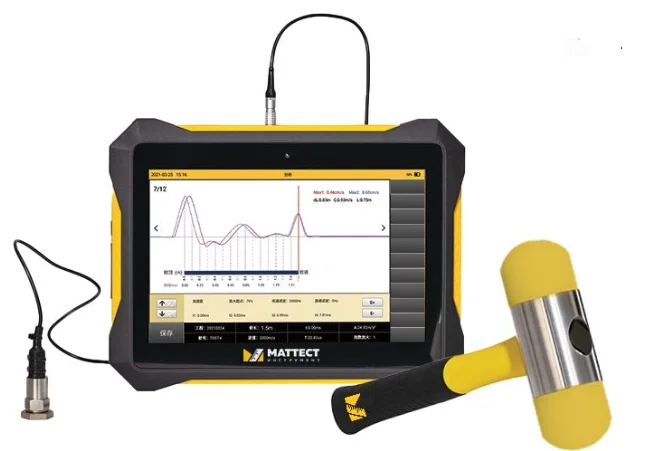
The instrument can display reflectograms in both direct and inverted form.
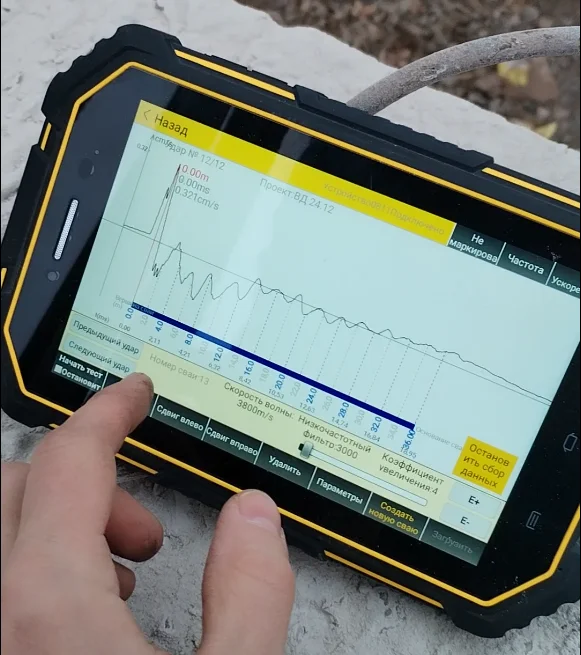
Signal analysis and editing
In the Zoom mode you can perform a detailed analysis of the acquired signal and edit it directly in field conditions.
Reflectograms acquired on site are assessed in terms of their stability (consistency between different impacts) and the presence of a reflection from the pile toe at the expected depth (given the known pile design). If reflections from defects are found in the section extending the first few metres from the pile head level, it is recommended to verify their presence immediately by inspecting the shaft (where the shaft is accessible for inspection along that section).
Data saving and office processing
The final stage of the test is saving the measurements to the instrument memory and copying them to a flash drive for further reflectogram processing under office conditions using the dedicated software supplied with the MIT KIK 1-1K.
Conclusions
The MIT KIK 1-1K seismic-acoustic pile diagnostics instrument is a complete solution for pile concrete integrity testing under construction-site conditions. It allows all requirements of the test methodology to be met and delivers a reliable result quickly in the field, so a conclusion about the pile concrete integrity can be made on the spot at the site.
Video showing the MIT KIK 1-1K in action — field operation, bar-velocity determination, work through the pile cap, and comparison with competing instruments — is available on the MIT KIK 1-1K product page in the "Video, photos and articles" section.
The MIT KIK line — seismic-acoustic pile concrete integrity testing
🔹 MIT KIK 1-1K (single-channel) — express testing on the construction site, one-hand operation.
🔹 MIT KIK 2-2K (dual-channel) — higher accuracy, preliminary signal-velocity determination.
Compliant with GOST R 72171-2025, PNST 804-2022 and STO EGEOS 1-1.2-001-2017.
Frequently asked questions
What is seismic-acoustic pile integrity testing and when is it used?
Seismic-acoustic pile integrity testing (SA KTsS; international equivalent — PIT, Pile Integrity Testing) is a non-destructive method for detecting defects within the pile body by recording reflected seismic-acoustic waves generated by an impact on the pile head. The method is used for inspection of bridge structures (SP 79.13330.2012), quality control of bored piles in foundations (SP 45.13330.2017), highways (SP 46.13330.2012) and high-rise buildings (SP 412.1325800.2018).
How does the MIT KIK 1-1K differ from the MIT KIK 2-2K?
The MIT KIK 1-1K is a single-channel instrument, compact and one-hand-operable; it is intended for everyday express measurements on a pile field. The MIT KIK 2-2K is a dual-channel instrument with higher accuracy and the ability to pre-determine signal propagation velocity between channels; it is suited to more complex tasks and detailed analysis.
Which GOSTs and standards does the method comply with?
Seismic-acoustic pile integrity testing is regulated by GOST R 72171-2025 (Piles. Field test methods), PNST 804-2022, STO EGEOS 1-1.2-001-2017, and the Technological Regulation by JSC TsNIIS on express integrity testing of piles by the "SONIK" method. The method is recommended by SP 79, SP 45, SP 46 and SP 412 for the corresponding facilities.
How many impacts are needed for a reliable result?
According to the MIT KIK 1-1K workflow, at least 12 impacts must be delivered to a single pile. The best result is achieved with a larger number of measurements (at least 30) and with the correct choice of impact source — hammers with metal or polymer tips are selected based on preliminary trial tests.
What does the reflectogram show and how is it analysed?
A reflectogram is a graphical display of seismic-acoustic signals reflected from the pile toe and from defects (if any are present). The MIT KIK 1-1K can display reflectograms in both direct and inverted form. Analysis is performed in the Zoom mode — the signal can be edited directly in field conditions to identify defects, their depth and their nature.
Can piles be tested through the pile cap?
Yes, the MIT KIK 1-1K allows seismic-acoustic pile integrity testing through the pile cap. A dedicated video demonstrating this workflow is available on the M-Instrument YouTube channel.
References
- СП 79.13330.2012. Свод правил. Мосты и трубы. Правила обследований и испытаний. Актуализированная редакция СНиП 3.06.04-82. — М., 2012.
- СП 45.13330.2017. Свод правил. Земляные сооружения, основания и фундаменты. Актуализированная редакция СНиП 3.02.01-87. — М., 2017.
- СП 46.13330.2012. Свод правил. Автомобильные дороги. Актуализированная редакция СНиП 2.05.02-85. — М., 2012.
- СП 412.1325800.2018. Свод правил. Конструкции фундаментов высотных зданий и сооружений. Правила производства работ. — М., 2018.
- ГОСТ Р 72171-2025. Сваи. Методы полевых испытаний. — М., 2025.
- Технологический регламент по применению неразрушающего экспресс-контроля сплошности свай методом «СОНИК» / ОАО ЦНИИС. — М., 2002.
- ПНСТ 804-2022. Предварительный национальный стандарт. Контроль неразрушающий. Сваи буровые. Требования к проведению ультразвукового контроля сплошности бетона. — М., 2022.
- СТО ЭГЕОС 1-1.2-001-2017. Стандарт организации. Геофизические исследования скважин. Методы и технологии / ООО «ЭГЕОС». — М., 2017.
- Руководство по контролю качества скрытых работ геофизическими методами при строительстве фундаментов глубокого заложения и подземных объектов, включая объекты метрополитена, на территории Москвы. — М., 2021.
Author: Denis Vorobev, Chief Laboratory Manager, MATTEST LLC. Expert text prepared for the website of the partner company M-Instrument LLC (MATTEST INSTRUMENT).